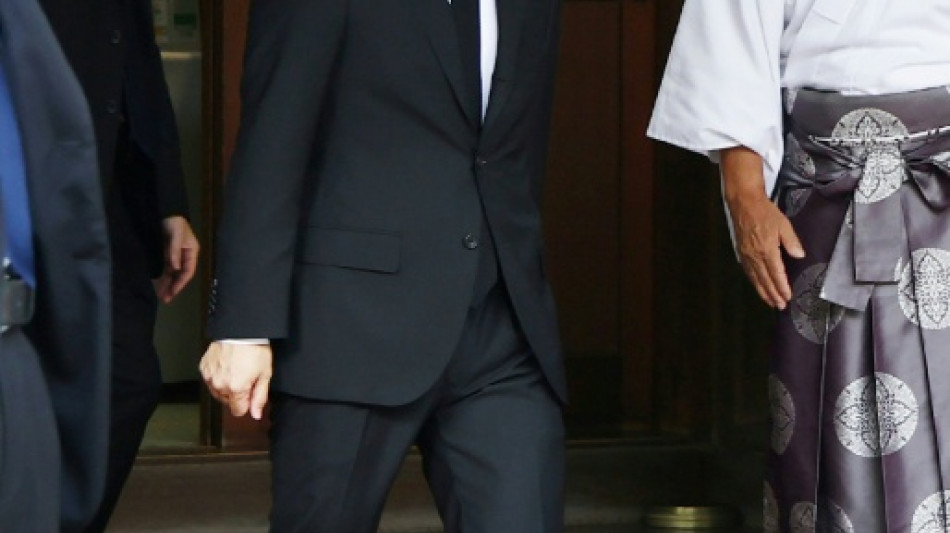
Japan defence minister visits war shrine, PM stays away / Photo: © JIJI Press/AFP

 London
 23 °C
23 °C

 Manchester
 16 °C
16 °C
 Glasgow
 18 °C
18 °C
 Dublin
16 °C
Dublin
16 °C
 Belfast
14 °C
Belfast
14 °C
 Washington
26 °C
Washington
26 °C
 Denver
18 °C
Denver
18 °C
 Atlanta
27 °C
Atlanta
27 °C
 Dallas
35 °C
Dallas
35 °C
 Houston Texas
30 °C
Houston Texas
30 °C
 New Orleans
 30 °C
30 °C
 El Paso
32 °C
El Paso
32 °C
 Phoenix
35 °C
Phoenix
35 °C
 Los Angeles
 23 °C
San Diego
23 °C
San Diego
 24 °C
San Francisco
17 °C
Chicago
24 °C
Minneapolis
23 °C
Seattle
25 °C
Portland
26 °C
Salt Lake City
23 °C
Las Vegas
28 °C
Miami
30 °C
Jacksonville
27 °C
San Antonio
30 °C
Bermuda
28 °C
Nassau
24 °C
Iqaluit
5 °C
Yellowknife
24 °C
San Francisco
17 °C
Chicago
24 °C
Minneapolis
23 °C
Seattle
25 °C
Portland
26 °C
Salt Lake City
23 °C
Las Vegas
28 °C
Miami
30 °C
Jacksonville
27 °C
San Antonio
30 °C
Bermuda
28 °C
Nassau
24 °C
Iqaluit
5 °C
Yellowknife
 15 °C
Anchorage
23 °C
Fairbanks
22 °C
Barrow
6 °C
Calgary
14 °C
Edmonton
15 °C
Anchorage
23 °C
Fairbanks
22 °C
Barrow
6 °C
Calgary
14 °C
Edmonton
 28 °C
Winnipeg
18 °C
Goose Bay
16 °C
Halifax
20 °C
Boston
21 °C
Ottawa
19 °C
Toronto
22 °C
Detroit
24 °C
Cleveland
22 °C
New York
26 °C
Baltimore
25 °C
Philadelphia
25 °C
Nuuk (Godthåb)
8 °C
Hong Kong
28 °C
Singapore
28 °C
Winnipeg
18 °C
Goose Bay
16 °C
Halifax
20 °C
Boston
21 °C
Ottawa
19 °C
Toronto
22 °C
Detroit
24 °C
Cleveland
22 °C
New York
26 °C
Baltimore
25 °C
Philadelphia
25 °C
Nuuk (Godthåb)
8 °C
Hong Kong
28 °C
Singapore
 28 °C
Melbourne
28 °C
Canberra
13 °C
Adelaide
15 °C
Darwin
30 °C
Perth
18 °C
Fort Worth
34 °C
Honolulu
30 °C
Sydney
15 °C
Johannesburg
3 °C
Dubai
35 °C
Mumbai
24 °C
Zürich
21 °C
Tokyo
29 °C
Seoul
29 °C
Delhi
27 °C
Beijing
22 °C
Riyadh
33 °C
Prague
18 °C
Pennsylvania
23 °C
Valletta
28 °C
Manama
36 °C
Warsaw
16 °C
Stockholm
17 °C
28 °C
Melbourne
28 °C
Canberra
13 °C
Adelaide
15 °C
Darwin
30 °C
Perth
18 °C
Fort Worth
34 °C
Honolulu
30 °C
Sydney
15 °C
Johannesburg
3 °C
Dubai
35 °C
Mumbai
24 °C
Zürich
21 °C
Tokyo
29 °C
Seoul
29 °C
Delhi
27 °C
Beijing
22 °C
Riyadh
33 °C
Prague
18 °C
Pennsylvania
23 °C
Valletta
28 °C
Manama
36 °C
Warsaw
16 °C
Stockholm
17 °C
Japan's defence minister paid his respects Saturday at a shrine honouring the country's war dead that has long dogged Tokyo's relations with its Asian neighbours, but Prime Minister Sanae Takaichi stayed away.
Shinjiro Koizumi's visit to the Yasukuni shrine took place 81 years after Japan's surrender in World War II, an anniversary when crowds, including a small number in military-style uniform -- and senior political figures -- throng the site.
There had been some speculation that Takaichi, a regular visitor before becoming prime minister in October, might attend the shrine like then-premier Shinzo Abe, her mentor, had done in 2013.
That visit sparked fury in China and South Korea and even a rare rebuke from close ally the United States.
Yasukuni is dedicated to 2.5 million war dead, mostly Japanese, including convicted war criminals involved in Imperial Japan's invasion and occupation of parts of Asia in the 1930s and 1940s.
Japan's neighbours have long seen the site and the regular visits by senior politicians as symbolic of the country's failure to atone for the atrocities its forces committed.
Koizumi has also long been a regular at Yasukuni, including as a government minister, but his first visit on Saturday as defence chief could rile Beijing, Seoul and Pyongyang.
Japanese defence ministers have attended Yasukuni before, the last one being Minoru Kihara in 2024.
Junichiro Koizumi, Shinjiro's father, was the last sitting prime minister to visit Yasukuni on the August 15 anniversary, in 2006. Abe did so in December 2013 on the first anniversary of taking office.
- China hawk -
Local media reported that Takaichi had sent an offering to the shrine, as previous prime ministers have done. She did the same for a spring festival earlier this year.
Japanese relations with South Korea have improved in recent years. In January Takaichi and President Lee Jae Myung jammed on the drums together, while Koizumi played ping-pong with his counterpart.
But Takaichi, seen before taking office as a China hawk, has already annoyed Beijing by suggesting in November that Japan would intervent militarily in any conflict over Taiwan.
China insists Taiwan is part of its territory and has threatened to use force to annex the self-ruled island of more than 23 million people.
China has since warned its citizens against travel to Japan and imposed trade restrictions, while also conducting regular patrols around disputed islands.
Takaichi has also accelerated a beefing up of Japan's military capabilities as its sheds its strict pacifist stance in place since the war.
A day ahead of the anniversary surrender, Senior Colonel Chen Xi, a spokesperson for the Chinese defence ministry, warned against Japanese "neo-militarism".
"We urge the Japanese side to earnestly reflect on itself, recognise and atone for its crimes, adhere to the post-war international order, and stop its dangerous acts of remilitarisation," Chen said.
China and Russia's ambassadors to Japan also issued a joint statement about their countries' sacrifices in World War II, Jiji Press reported.
On Thursday Russian President Vladimir Putin visited the Kuril islands in Russia's far-east for the first time, sparking a strong protest Japan which also claims the territories.
- Uniforms guidance -
Yasukuni this week also appealed to visitors to refrain from wearing military-style uniforms so that the "general public can worship in peace and quiet at our shrine".
It remained to be seen if the guidance would be adhered to on Saturday, with the shrine saying staff would "provide guidance" at the entrance to those "unaware".
"While these are merely requests and do not imply that visitors will be forcibly asked to leave, we earnestly ask for your understanding of the intent behind these guidelines and your cooperation," its statement said.
An AFP reporter estimated that around 20-30 people in uniforms were there.
V.Bae--SG