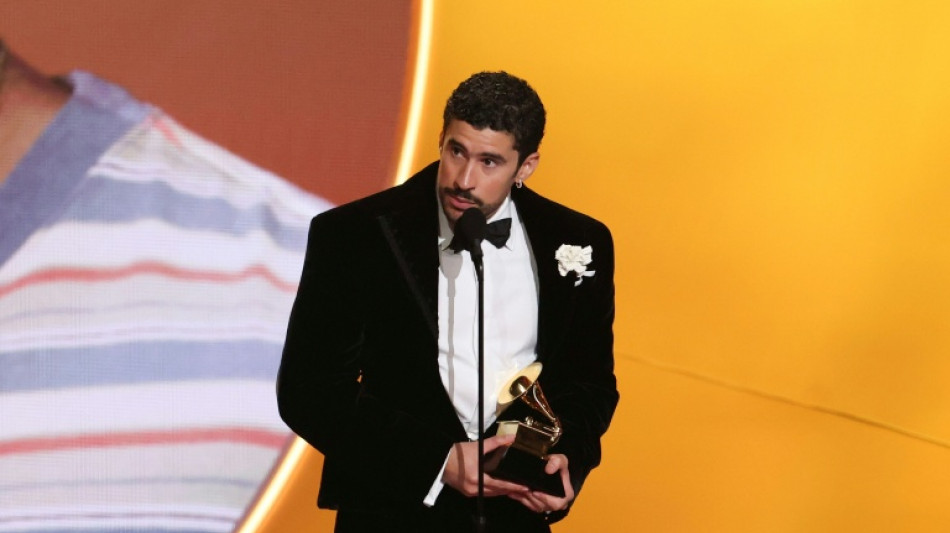
Bad Bunny: the Puerto Rican phenom on top of the music world / Photo: © AFP

 London
 19 °C
19 °C
 Manchester
15 °C
Manchester
15 °C
 Glasgow
 15 °C
15 °C
 Dublin
16 °C
Dublin
16 °C
 Belfast
15 °C
Belfast
15 °C
 Washington
32 °C
Washington
32 °C
 Denver
 30 °C
30 °C
 Atlanta
35 °C
Atlanta
35 °C
 Dallas
 38 °C
38 °C
 Houston Texas
 36 °C
36 °C
 New Orleans
34 °C
New Orleans
34 °C
 El Paso
33 °C
El Paso
33 °C
 Phoenix
36 °C
Phoenix
36 °C
 Los Angeles
28 °C
San Diego
27 °C
San Francisco
16 °C
Chicago
25 °C
Minneapolis
24 °C
Seattle
23 °C
Portland
25 °C
Salt Lake City
34 °C
Las Vegas
38 °C
Miami
34 °C
Jacksonville
34 °C
San Antonio
35 °C
Bermuda
30 °C
Nassau
27 °C
Iqaluit
10 °C
Yellowknife
14 °C
Anchorage
12 °C
Fairbanks
13 °C
Barrow
5 °C
Calgary
23 °C
Edmonton
28 °C
Winnipeg
20 °C
Goose Bay
20 °C
Halifax
29 °C
Boston
30 °C
Ottawa
23 °C
Toronto
23 °C
Detroit
26 °C
Cleveland
26 °C
New York
28 °C
Baltimore
29 °C
Philadelphia
27 °C
Nuuk (Godthåb)
11 °C
Hong Kong
26 °C
Singapore
28 °C
Melbourne
32 °C
Canberra
11 °C
Adelaide
Los Angeles
28 °C
San Diego
27 °C
San Francisco
16 °C
Chicago
25 °C
Minneapolis
24 °C
Seattle
23 °C
Portland
25 °C
Salt Lake City
34 °C
Las Vegas
38 °C
Miami
34 °C
Jacksonville
34 °C
San Antonio
35 °C
Bermuda
30 °C
Nassau
27 °C
Iqaluit
10 °C
Yellowknife
14 °C
Anchorage
12 °C
Fairbanks
13 °C
Barrow
5 °C
Calgary
23 °C
Edmonton
28 °C
Winnipeg
20 °C
Goose Bay
20 °C
Halifax
29 °C
Boston
30 °C
Ottawa
23 °C
Toronto
23 °C
Detroit
26 °C
Cleveland
26 °C
New York
28 °C
Baltimore
29 °C
Philadelphia
27 °C
Nuuk (Godthåb)
11 °C
Hong Kong
26 °C
Singapore
28 °C
Melbourne
32 °C
Canberra
11 °C
Adelaide
 10 °C
Darwin
23 °C
Perth
10 °C
Darwin
23 °C
Perth
 12 °C
Fort Worth
38 °C
Honolulu
26 °C
Sydney
12 °C
Fort Worth
38 °C
Honolulu
26 °C
Sydney
 16 °C
Johannesburg
17 °C
Dubai
36 °C
Mumbai
29 °C
Zürich
21 °C
Tokyo
27 °C
Seoul
25 °C
Delhi
31 °C
Beijing
25 °C
Riyadh
16 °C
Johannesburg
17 °C
Dubai
36 °C
Mumbai
29 °C
Zürich
21 °C
Tokyo
27 °C
Seoul
25 °C
Delhi
31 °C
Beijing
25 °C
Riyadh
 37 °C
Prague
24 °C
Pennsylvania
25 °C
Valletta
29 °C
Manama
35 °C
Warsaw
22 °C
Stockholm
19 °C
37 °C
Prague
24 °C
Pennsylvania
25 °C
Valletta
29 °C
Manama
35 °C
Warsaw
22 °C
Stockholm
19 °C
A musical deep dive into colonial legacy, an epic concert residency, an oeuvre of smash albums with remarkable range: no one is doing it quite like Bad Bunny.
And on Sunday, the Puerto Rican phenom made history, winning the coveted Grammy for Album of the Year -- and becoming the first artist who performs in Spanish to ever claim the prize.
And he came out swinging at President Donald Trump's sweeping immigration crackdown, earning cheers when he told the Grammys audience: "ICE out."
"I want to dedicate this award to all the people who had to leave their homeland, their country to follow their dreams," Bad Bunny said as he accepted his groundbreaking gramophone.
He won two other prizes on the night -- for best global music performance and best musica urbana album.
The Grammys were an appropriate exclamation point on an extraordinary year that has cemented the 31-year-old's reign over global music.
Benito Antonio Martinez Ocasio's career is barely a decade old, but it's marked by historic milestones that have broken barriers for Latin and Spanish-language music.
In just one week, he'll helm the world's most visible stage at the Super Bowl halftime show, the first Spanish-language artist ever to do so.
Bad Bunny was the first -- and remains the only -- Spanish-language artist to ever receive an Album of the Year Grammy nod.
He's earned it twice, for Sunday's winner "Debi Tirar Mas Fotos" and in 2022, for "Un Verano Sin Ti."
He also was the first Spanish-language artist to ever headline Coachella, delivering a two-hour performance in 2023 that included documentary footage and traditional dance.
That set foreshadowed the history lesson in Puerto Rican music Bad Bunny would soon give with "Debi Tirar Mas Fotos," which he promoted with a hometown concert residency.
The first nine shows were only open to residents of the Caribbean island that has been under US rule since 1898.
He then launched a world tour in support of the album -- but with no scheduled stops on the US mainland, out of fear that federal immigration agents would target concertgoers.
Bad Bunny has been Spotify's most-streamed artist four separate times, including in 2025, beating out the likes of titans like Taylor Swift and Drake.
He is wildly popular both stateside and abroad, a commercial golden goose who is critically acclaimed and commands legions of ardent fans.
- 'Deeply political' -
The son of a truck driver and a teacher, Bad Bunny was born on March 10, 1994 and grew up in Vega Baja, a small municipality near Puerto Rico's capital San Juan.
He honed his vocal skills in the children's choir at church, before growing into a pre-teen who loved spending hours developing beats on his computer, as he also began delving into everything from bachata to the Bee Gees.
He was working at a supermarket bagging groceries when he got a call from a label over his viral plays on the DIY platform SoundCloud.
Thus began the reggaeton star's rapid explosion to the top of global music.
With his enormous fame came pressure to meet the varying expectations of loyal fans, including those who wanted him to take stronger political stances.
Earlier in his career, he wavered on taking up a role as a de facto spokesperson.
But more recently, he has joined Puerto Rican protests and spoken out against US President Donald Trump's policies. His statement on the Grammys stage was perhaps his most direct yet.
"Debi Tirar Mas Fotos" was a full-throated, identity-affirming exploration of Puerto Ricanness in the context of persistent colonialism, set to folkloric sounds, infectious salsa and reggaeton rhythms.
It was a love letter to his home, for his home -- and it brought positive visibility to a place often viewed through a lens of suffering.
The artist's commitment to singing in Spanish in a music industry that has historically marginalized Latino voices makes his mammoth success even more extraordinary.
Historian Jorell Melendez-Badillo told AFP the artist's mere presence at major cultural events like the Grammys or the Super Bowl is "deeply political."
And all those sociopolitical layers come packaged in eminently danceable form: it's hard to attend a Bad Bunny show and resist the urge to twerk.
V.Pyo--SG