It's go time: historic Moon mission set for lift-off / Photo: © AFP

 London
 19 °C
19 °C

 Manchester
14 °C
Manchester
14 °C
 Glasgow
 18 °C
18 °C
 Dublin
15 °C
Dublin
15 °C
 Belfast
14 °C
Belfast
14 °C
 Washington
24 °C
Washington
24 °C
 Denver
 17 °C
17 °C
 Atlanta
25 °C
Atlanta
25 °C
 Dallas
 31 °C
31 °C
 Houston Texas
27 °C
Houston Texas
27 °C
 New Orleans
28 °C
New Orleans
28 °C
 El Paso
24 °C
El Paso
24 °C
 Phoenix
34 °C
Phoenix
34 °C
 Los Angeles
20 °C
San Diego
20 °C
San Francisco
14 °C
Chicago
Los Angeles
20 °C
San Diego
20 °C
San Francisco
14 °C
Chicago
 23 °C
Minneapolis
22 °C
Seattle
23 °C
Minneapolis
22 °C
Seattle
 16 °C
Portland
17 °C
Salt Lake City
21 °C
Las Vegas
28 °C
Miami
29 °C
Jacksonville
26 °C
San Antonio
26 °C
Bermuda
27 °C
Nassau
21 °C
Iqaluit
8 °C
Yellowknife
11 °C
Anchorage
14 °C
Fairbanks
18 °C
Barrow
13 °C
Calgary
13 °C
Edmonton
24 °C
Winnipeg
15 °C
Goose Bay
12 °C
Halifax
13 °C
Boston
15 °C
Ottawa
14 °C
Toronto
19 °C
Detroit
23 °C
Cleveland
23 °C
New York
22 °C
Baltimore
24 °C
Philadelphia
21 °C
Nuuk (Godthåb)
16 °C
Portland
17 °C
Salt Lake City
21 °C
Las Vegas
28 °C
Miami
29 °C
Jacksonville
26 °C
San Antonio
26 °C
Bermuda
27 °C
Nassau
21 °C
Iqaluit
8 °C
Yellowknife
11 °C
Anchorage
14 °C
Fairbanks
18 °C
Barrow
13 °C
Calgary
13 °C
Edmonton
24 °C
Winnipeg
15 °C
Goose Bay
12 °C
Halifax
13 °C
Boston
15 °C
Ottawa
14 °C
Toronto
19 °C
Detroit
23 °C
Cleveland
23 °C
New York
22 °C
Baltimore
24 °C
Philadelphia
21 °C
Nuuk (Godthåb)
 7 °C
Hong Kong
33 °C
Singapore
31 °C
Melbourne
26 °C
Canberra
11 °C
Adelaide
7 °C
Hong Kong
33 °C
Singapore
31 °C
Melbourne
26 °C
Canberra
11 °C
Adelaide
 14 °C
Darwin
29 °C
Perth
24 °C
Fort Worth
30 °C
Honolulu
26 °C
Sydney
15 °C
Johannesburg
14 °C
Dubai
37 °C
Mumbai
31 °C
Zürich
25 °C
Tokyo
25 °C
Seoul
26 °C
Delhi
33 °C
Beijing
27 °C
Riyadh
44 °C
Prague
23 °C
Pennsylvania
21 °C
Valletta
30 °C
Manama
42 °C
Warsaw
25 °C
Stockholm
18 °C
14 °C
Darwin
29 °C
Perth
24 °C
Fort Worth
30 °C
Honolulu
26 °C
Sydney
15 °C
Johannesburg
14 °C
Dubai
37 °C
Mumbai
31 °C
Zürich
25 °C
Tokyo
25 °C
Seoul
26 °C
Delhi
33 °C
Beijing
27 °C
Riyadh
44 °C
Prague
23 °C
Pennsylvania
21 °C
Valletta
30 °C
Manama
42 °C
Warsaw
25 °C
Stockholm
18 °C
More than half-a-century after the groundbreaking Apollo program's last crewed flight to the Moon, three men and one woman are preparing for a lunar journey set to turn a new page in American space exploration.
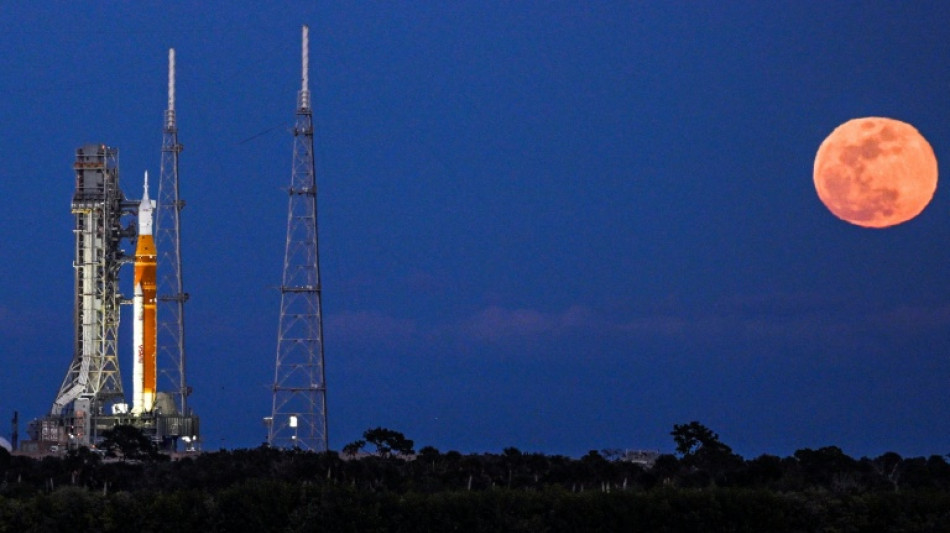
The long-delayed NASA mission dubbed Artemis II is slated to lift-off from Florida and venture to Earth's natural satellite as early as April 1.
They won't land but are instead on a mission to fly by, much as Apollo 8 did in 1968.
Americans Reid Wiseman, Victor Glober and Christina Koch -- along with Canadian Jeremy Hansen -- will carry out the approximately 10-day trip.
The odyssey will mark a series of firsts: the first time a woman, a person of color and a non-American will venture on a Moon mission.
It's also the inaugural crewed flight of NASA's new lunar rocket, dubbed SLS.
The mammoth orange-and-white rocket is designed to allow the United States to repeatedly return to the Moon in years to come, with the goal of establishing a permanent base that will offer a stepping stone for further exploration.
"We're going back to the Moon because it's the next step in our journey to Mars," said Wiseman, the Artemis II commander, on a NASA podcast.
- Space Race 2.0? -
The Artemis program -- named in honor of Apollo's goddess twin -- aims to test technologies needed to one day send humans to Mars, a far more distant journey.
That ambition presents an immense challenge -- which is compounded by pressure to achieve it before China does.
China is currently aiming to land humans on the Moon by 2030.
Beijing is also targeting the lunar South Pole, not least for its rich natural resource potential.
The competition recalls the 1960s-era Space Race between the US and the Soviet Union -- but Harvard professor Matthew Hersch said that rivalry was "unique" and "will not be repeated anytime soon."
He told AFP the Chinese are "not really competing with anyone but themselves."
Washington's lunar program investment is significantly lower now than during the Cold War era -- but the technology has changed dramatically.
"The computer technology that supports the Artemis 2 crew would be almost unimaginable to the Apollo 8 crew, which went to the Moon in a spacecraft with the electronics of a modern high-end toaster oven," Hersch said.
And yet the Artemis 2 mission will not be without risks, even by NASA's own admission.
The crew will board a spacecraft that has never once carried humans or traveled to the Moon, which is more than 384,000 kilometers (238,855 miles) from Earth -- or roughly 1,000 times further away than the International Space Station.
"We don't accept anything less than perfect, otherwise we're accepting greater risk," NASA's former chief astronaut Peggy Whitson told AFP.
"That is an important process that everyone has to embrace in order for us to be really successful, because we have to live with that knowledge, because of our space flight history, that when accidents happen, people will die," she said.
Minimizing risks and preventing disaster will involve the crew performing a series of checks and maneuvers while still in Earth's vicinity.
If all goes well, they'll set forth for the Moon.
- Ambitious timeline -
The crew's objective will be to verify that both the rocket and the spacecraft are in working order, in the hopes of paving the way for a return and Moon landing in 2028 -- the final year of President Donald Trump's term.
That deadline has raised eyebrows among experts, in part because Washington is relying on the private sector's technological headway.
The astronauts will require a second vehicle to descend to the moon's surface, a lunar lander that remains under development by rival space companies owned by billionaires Elon Musk and Jeff Bezos.
The Artemis program has also been plagued by delays and massive cost overruns.
Still, NASA hopes that Artemis 2 can succeed in recreating the rare moment of unity and hope that Apollo 8, when a crew flew by the Moon on Christmas Eve 1968, allowed for.
In the shadow of a tumultuous year, approximately one billion people worldwide tuned in to their flickering television sets to follow the monumental journey of Frank Borman, Jim Lovell and Bill Anders.
The astronauts -- who immortalized the famous "Earthrise" photograph taken from lunar orbit -- were credited with having "saved 1968."
Nearly 60 years later, the country is once again mired in deep division and uncertainty, and the crew of Artemis 2 will soon have their chance to inspire.
F.Kang--SG