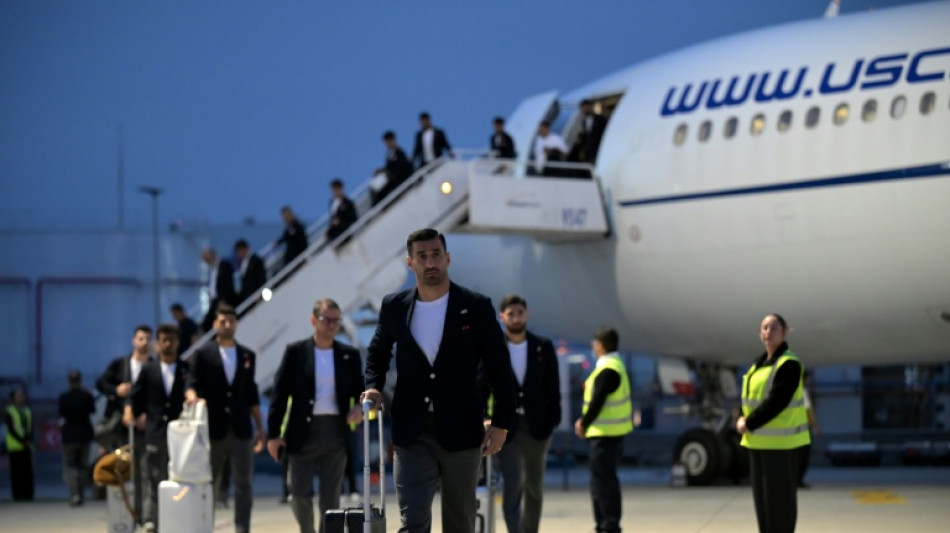
Iran's World Cup team blast US visa row on arrival in Mexico / Photo: © AFP

 London
 23 °C
23 °C

 Manchester
21 °C
Manchester
21 °C
 Glasgow
21 °C
Glasgow
21 °C
 Dublin
19 °C
Dublin
19 °C
 Belfast
17 °C
Belfast
17 °C
 Washington
22 °C
Washington
22 °C
 Denver
17 °C
Denver
17 °C
 Atlanta
 26 °C
26 °C
 Dallas
 31 °C
31 °C
 Houston Texas
32 °C
Houston Texas
32 °C
 New Orleans
30 °C
New Orleans
30 °C
 El Paso
22 °C
El Paso
22 °C
 Phoenix
21 °C
Phoenix
21 °C
 Los Angeles
23 °C
San Diego
21 °C
San Francisco
17 °C
Chicago
22 °C
Minneapolis
Los Angeles
23 °C
San Diego
21 °C
San Francisco
17 °C
Chicago
22 °C
Minneapolis
 19 °C
Seattle
15 °C
Portland
15 °C
Salt Lake City
16 °C
Las Vegas
19 °C
Miami
26 °C
Jacksonville
29 °C
San Antonio
30 °C
Bermuda
29 °C
Nassau
20 °C
Iqaluit
2 °C
Yellowknife
5 °C
Anchorage
7 °C
Fairbanks
3 °C
Barrow
-3 °C
Calgary
12 °C
Edmonton
25 °C
Winnipeg
16 °C
Goose Bay
15 °C
Halifax
16 °C
Boston
17 °C
Ottawa
13 °C
Toronto
20 °C
Detroit
21 °C
Cleveland
22 °C
New York
21 °C
Baltimore
22 °C
Philadelphia
21 °C
Nuuk (Godthåb)
3 °C
Hong Kong
19 °C
Seattle
15 °C
Portland
15 °C
Salt Lake City
16 °C
Las Vegas
19 °C
Miami
26 °C
Jacksonville
29 °C
San Antonio
30 °C
Bermuda
29 °C
Nassau
20 °C
Iqaluit
2 °C
Yellowknife
5 °C
Anchorage
7 °C
Fairbanks
3 °C
Barrow
-3 °C
Calgary
12 °C
Edmonton
25 °C
Winnipeg
16 °C
Goose Bay
15 °C
Halifax
16 °C
Boston
17 °C
Ottawa
13 °C
Toronto
20 °C
Detroit
21 °C
Cleveland
22 °C
New York
21 °C
Baltimore
22 °C
Philadelphia
21 °C
Nuuk (Godthåb)
3 °C
Hong Kong
 30 °C
Singapore
30 °C
Singapore
 28 °C
Melbourne
29 °C
Canberra
5 °C
Adelaide
28 °C
Melbourne
29 °C
Canberra
5 °C
Adelaide
 20 °C
Darwin
27 °C
Perth
15 °C
Fort Worth
29 °C
Honolulu
24 °C
Sydney
20 °C
Darwin
27 °C
Perth
15 °C
Fort Worth
29 °C
Honolulu
24 °C
Sydney
 11 °C
Johannesburg
10 °C
Dubai
34 °C
Mumbai
27 °C
Zürich
25 °C
Tokyo
17 °C
Seoul
17 °C
Delhi
27 °C
Beijing
19 °C
Riyadh
37 °C
Prague
22 °C
Pennsylvania
21 °C
Valletta
11 °C
Johannesburg
10 °C
Dubai
34 °C
Mumbai
27 °C
Zürich
25 °C
Tokyo
17 °C
Seoul
17 °C
Delhi
27 °C
Beijing
19 °C
Riyadh
37 °C
Prague
22 °C
Pennsylvania
21 °C
Valletta
 25 °C
Manama
34 °C
Warsaw
19 °C
Stockholm
16 °C
25 °C
Manama
34 °C
Warsaw
19 °C
Stockholm
16 °C
Iran's World Cup squad landed in Mexico on Sunday under the shadow of a bitter diplomatic row, after the United States -- in open military conflict with Tehran -- refused to issue visas for some team support staff.
Iran coach Amir Ghalenoei complained on arrival at Tijuana airport that "we should have been here last week because a 12-hour time difference needs two weeks of adjusting."
He added: "Usually in these tournaments, before technical matters, ethical and human considerations must be respected -- which I think for us it was not the case."
The dispute erupted just days before Thursday's kickoff of the 2026 World Cup, which is being jointly hosted by the United States, Mexico and Canada.
After departing from their training camp in Turkey a day earlier, the Iran team landed around 5 am (1200 GMT) Sunday in the Mexican border city of Tijuana, AFP journalists there witnessed.
The squad and their coaching staff left their plane amid tight security which included a contingent of Mexican national guard troops. Just a handful of fans waving Iranian flags were present at the airport to welcome them from a distance.
The Iranian team will be based in Tijuana throughout the tournament, despite playing their entire group stage in the United States -- two games in Los Angeles and another in Seattle as they tackle New Zealand, Belgium and Egypt in Group G on June 15, 21 and 26.
When they do play in the US, it will be the first World Cup to see a host nation receive the team of a country it is at war with.
- 'Upset' -
Ghalenoei thanked FIFA for its efforts to help secure entry, but said "we are upset about this behaviour. It has certainly never happened before."
Team captain Ehsan Hajsafi said he wanted to convey his grievance to FIFA about the delay in getting US visas. "Why so late?" he demanded.
Hajsafi stressed the difficult backdrop for the team's participation, as "in the last year, we experienced two imposed wars in our country."
But he stated "the team is 100% ready" and believed "we can advance" in its group matches."
Another player, Alireza Jahanbakhsh, said the team's condition was "positive" after a good training camp. "We are surely doing all we can to prepare for the first game against New Zealand."
Iran's team spent nearly three weeks at the training camp in Turkey, using their time there to apply for visas to travel to Mexico, Canada and the United States.
On the eve of their departure for Mexico, the players finally received their US visas, Washington's envoy to Turkey Tom Barrack said on X late Friday.
But Iran's embassy to Turkey said support staff had been denied visas -- 15 administrative and management staff are concerned, an Iranian diplomat and state TV said.
The embassy slammed what it called "deliberate and discriminatory treatment against Iran's national football team" and called for FIFA "to hold the US accountable for violations of its rules."
Adding to the tensions, Iran's ambassador to Mexico said Saturday the squad had been notified that, under their visa conditions, the team must enter and leave US soil on the same day as their matches.
"We can enter in the morning and we must leave the same day," Iran's envoy Abolfazl Pasandideh told reporters.
That appeared to contradict what the team's spokesman Amir Mahdi Alavi told state TV earlier.
"The visas issued for the national team are multiple-entry visas, and the national team will arrive at the match venue one day before the first game and, for the following games, two days prior to each match," Alavi said.
FIFA rules for World Cups stipulate that a team's coach must give a news conference on the eve of the match at the venue where the game will be played.
- US wary of 'terrorists' -
Iran's Football Federation -- whose chief Mehdi Taj was reportedly among those denied a visa -- has described the decision as "political interference in sport in its worst form."
A US administration official did not directly address the matter of those whose visas were refused, saying only: "We will not allow the Iranian team to abuse this system to sneak terrorists into the United States under false pretenses."
In April, US Secretary of State Marco Rubio said any problem would not be with the Iranian players but "some of the other people (they) would want to bring with them," suggesting some had ties to the Revolutionary Guards, a group on the US terror blacklist.
Taj himself is a former Guards member, Iranian media in the diaspora have reported.
Daniel Mercado, working at a taqueria eatery near the heavily-guarded Tijuana hotel hosting Iran's team said he regretted the politicization of the sport.
The Middle East war erupted when the United States and Israel started bombing Iran on February 28.
An April 8 ceasefire, which largely halted the fighting, has come under strain from recent exchanges of fire.
E.Yeon--SG