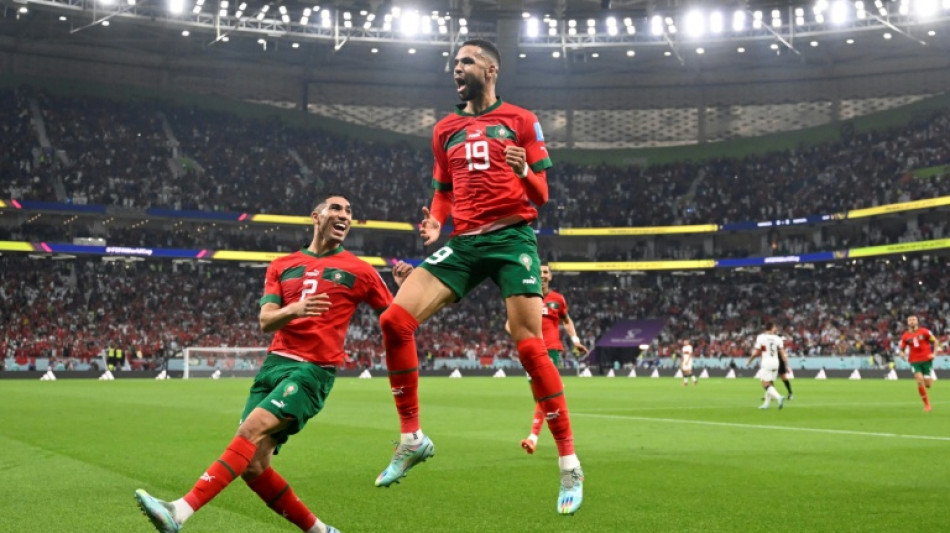
Morocco's dual-national scouting policy pays rich dividends / Photo: © AFP

 London
 21 °C
21 °C

 Manchester
20 °C
Manchester
20 °C
 Glasgow
20 °C
Glasgow
20 °C
 Dublin
18 °C
Dublin
18 °C
 Belfast
19 °C
Belfast
19 °C
 Washington
23 °C
Washington
23 °C
 Denver
21 °C
Denver
21 °C
 Atlanta
 29 °C
29 °C
 Dallas
35 °C
Dallas
35 °C
 Houston Texas
 31 °C
31 °C
 New Orleans
31 °C
New Orleans
31 °C
 El Paso
25 °C
El Paso
25 °C
 Phoenix
 27 °C
27 °C
 Los Angeles
29 °C
San Diego
26 °C
San Francisco
Los Angeles
29 °C
San Diego
26 °C
San Francisco
 25 °C
Chicago
25 °C
Minneapolis
17 °C
Seattle
16 °C
Portland
19 °C
Salt Lake City
22 °C
Las Vegas
23 °C
Miami
26 °C
Jacksonville
30 °C
San Antonio
35 °C
Bermuda
29 °C
Nassau
20 °C
Iqaluit
3 °C
Yellowknife
6 °C
Anchorage
9 °C
Fairbanks
3 °C
Barrow
-2 °C
Calgary
18 °C
Edmonton
29 °C
Winnipeg
22 °C
Goose Bay
14 °C
Halifax
17 °C
Boston
18 °C
Ottawa
15 °C
Toronto
20 °C
Detroit
24 °C
Cleveland
23 °C
New York
21 °C
Baltimore
24 °C
Philadelphia
22 °C
Nuuk (Godthåb)
2 °C
Hong Kong
25 °C
Chicago
25 °C
Minneapolis
17 °C
Seattle
16 °C
Portland
19 °C
Salt Lake City
22 °C
Las Vegas
23 °C
Miami
26 °C
Jacksonville
30 °C
San Antonio
35 °C
Bermuda
29 °C
Nassau
20 °C
Iqaluit
3 °C
Yellowknife
6 °C
Anchorage
9 °C
Fairbanks
3 °C
Barrow
-2 °C
Calgary
18 °C
Edmonton
29 °C
Winnipeg
22 °C
Goose Bay
14 °C
Halifax
17 °C
Boston
18 °C
Ottawa
15 °C
Toronto
20 °C
Detroit
24 °C
Cleveland
23 °C
New York
21 °C
Baltimore
24 °C
Philadelphia
22 °C
Nuuk (Godthåb)
2 °C
Hong Kong
 29 °C
Singapore
29 °C
Singapore
 28 °C
Melbourne
30 °C
Canberra
3 °C
Adelaide
19 °C
Darwin
23 °C
Perth
28 °C
Melbourne
30 °C
Canberra
3 °C
Adelaide
19 °C
Darwin
23 °C
Perth
 14 °C
Fort Worth
34 °C
Honolulu
29 °C
Sydney
10 °C
Johannesburg
10 °C
Dubai
34 °C
Mumbai
27 °C
Zürich
19 °C
Tokyo
18 °C
Seoul
15 °C
Delhi
25 °C
Beijing
15 °C
Riyadh
33 °C
Prague
15 °C
Pennsylvania
22 °C
Valletta
24 °C
Manama
33 °C
Warsaw
14 °C
Stockholm
11 °C
14 °C
Fort Worth
34 °C
Honolulu
29 °C
Sydney
10 °C
Johannesburg
10 °C
Dubai
34 °C
Mumbai
27 °C
Zürich
19 °C
Tokyo
18 °C
Seoul
15 °C
Delhi
25 °C
Beijing
15 °C
Riyadh
33 °C
Prague
15 °C
Pennsylvania
22 °C
Valletta
24 °C
Manama
33 °C
Warsaw
14 °C
Stockholm
11 °C
For a while, dual-national footballers were a rarity in the Moroccan national team, but today they account for the majority of players across age groups and have become the Atlas Lions' greatest strength.
Back when Morocco saw recruiting dual nationals as an occasional backup option, many foreign-born Moroccan players opted for their countries of birth instead.
They included the Netherlands' Ibrahim Afellay, Belgium's Marouane Fellaini, and France's Adil Rami.
But today, attracting that kind of talent has become central to the Moroccan team's sporting strategy, not least as the Atlas Lions eye improving on reaching the semi-finals in 2022 and competing with the globe's leading football nations.
"For me it was quite an easy choice to make," recalled Ryan Mmaee, who alongside his brother Sami choose to represent Morocco in 2018 instead of Cameroon or Belgium.
"When I was called up, I saw that Morocco was making a lot of effort to put players in the best conditions," the 29-year-old Omonia Nicosia forward told AFP.
"Everything was well thought out -- a real project. That's what attracted me."
The North African kingdom has relied on a sprawling network of scouts in Europe to identify young talent while drawing on the Moroccan diaspora's attachment to the country and the influence the players' families have on their decisions.
This course of action is driven by "a clear strategic vision", said the Moroccan football federation's technical director, Fathi Jamal.
"We have a hybrid and intelligent model: some players come through local development, via national academies and club training centres, whereas others are spotted in Europe through a dedicated unit that follows young dual-national talents," Jamal added.
- 'Choice of heart' -
Head coach Mohamed Ouahbi, appointed in March, recently told Belgian broadcaster RTBF the federation closely tracks dual-national prospects.
"The federation works with lists of dual-national players," he said.
"All of these players are assessed through reports from our scouts. When a report is positive, there is initial contact to find out whether the player has already made a choice. There is nothing aggressive. We offer nothing -- no money, nothing.
"What I do, when it falls within my team's responsibilities, is travel to meet the (player's) parents and present a sporting project in the short, medium, and long term," added the manager who guided Morocco's Under-20s to the World Cup title last year.
Morocco's failure to qualify for the 1998 World Cup marked a turning point in its efforts to recruit dual nationals.
Since then, players such as Hakim Ziyech, Achraf Hakimi, and Noussair Mazraoui have become key figures for the national team, while younger talents such as Ayyoub Bouaddi have also chosen Morocco.
Paris Saint-Germain defender Hakimi, one of the pillars of the Moroccan team, described representing Morocco as "the choice of the heart".
"I tried the experience (with Spain), but I didn't feel comfortable," said Hakimi, who was born in Spain and came through the Real Madrid academy.
"The decision to represent a country must be made from the start, and you have to feel comfortable with it, both personally and within your family."
Ziyech, Ajax Amsterdam's onetime star winger, also said the choice must come "from the heart".
"In my case, it was Morocco without hesitation. I have always felt Moroccan even though I was born (in the Netherlands). Many people will never understand that feeling."
Still, many dual-national players continue to opt for the countries where they were born.
Barcelona star Lamine Yamal, who was approached by Morocco, ultimately chose to represent Spain.
- 'It's their right' -
The kingdom's investments in sports infrastructure and talent development has delivered positive results in recent years for the Atlas Lions.
The country reached the semi-finals of the 2022 World Cup, won the 2023 Under-23 Africa Cup of Nations, claimed bronze at the 2024 Olympic Games, finished runners-up at the 2025 Under-20 Africa Cup of Nations, and won the Under-20 World Cup later that year.
Morocco was also awarded the 2025 Africa Cup of Nations title after Senegal was declared to have forfeited the match, but the decision is pending a final ruling by the Court of Arbitration for Sport this year.
The growing number of dual-national players choosing Morocco has drawn criticism in some European countries, particularly Belgium and the Netherlands.
"Moroccans who are not good enough (in the Netherlands) go and play for Morocco," former Dutch international Rafael van der Vaart said.
Belgium sporting director Vincent Mannaert struck a more measured tone: "They were born here and received their education in Belgium, where clubs invested a lot of time and energy... but if, at a certain point, they cannot choose Belgium, it is their right."
J.Gong--SG