China's Xi to visit North Korea after meetings with Trump, Putin / Photo: © KCNA VIA KNS/AFP/File

 London
 18 °C
18 °C

 Manchester
17 °C
Manchester
17 °C
 Glasgow
15 °C
Glasgow
15 °C
 Dublin
 16 °C
16 °C
 Belfast
16 °C
Belfast
16 °C
 Washington
23 °C
Washington
23 °C
 Denver
22 °C
Denver
22 °C
 Atlanta
 25 °C
25 °C
 Dallas
30 °C
Dallas
30 °C
 Houston Texas
 32 °C
32 °C
 New Orleans
27 °C
New Orleans
27 °C
 El Paso
29 °C
El Paso
29 °C
 Phoenix
35 °C
Phoenix
35 °C
 Los Angeles
21 °C
San Diego
21 °C
San Francisco
16 °C
Chicago
17 °C
Minneapolis
14 °C
Seattle
22 °C
Portland
20 °C
Salt Lake City
24 °C
Las Vegas
36 °C
Miami
29 °C
Jacksonville
26 °C
San Antonio
30 °C
Bermuda
27 °C
Nassau
21 °C
Iqaluit
6 °C
Yellowknife
16 °C
Anchorage
Los Angeles
21 °C
San Diego
21 °C
San Francisco
16 °C
Chicago
17 °C
Minneapolis
14 °C
Seattle
22 °C
Portland
20 °C
Salt Lake City
24 °C
Las Vegas
36 °C
Miami
29 °C
Jacksonville
26 °C
San Antonio
30 °C
Bermuda
27 °C
Nassau
21 °C
Iqaluit
6 °C
Yellowknife
16 °C
Anchorage
 12 °C
Fairbanks
14 °C
Barrow
2 °C
Calgary
19 °C
Edmonton
18 °C
Winnipeg
20 °C
Goose Bay
12 °C
Fairbanks
14 °C
Barrow
2 °C
Calgary
19 °C
Edmonton
18 °C
Winnipeg
20 °C
Goose Bay
 13 °C
Halifax
17 °C
Boston
18 °C
Ottawa
12 °C
Toronto
14 °C
Detroit
15 °C
Cleveland
12 °C
New York
22 °C
Baltimore
22 °C
Philadelphia
22 °C
Nuuk (Godthåb)
7 °C
Hong Kong
33 °C
Singapore
30 °C
Melbourne
27 °C
Canberra
13 °C
Halifax
17 °C
Boston
18 °C
Ottawa
12 °C
Toronto
14 °C
Detroit
15 °C
Cleveland
12 °C
New York
22 °C
Baltimore
22 °C
Philadelphia
22 °C
Nuuk (Godthåb)
7 °C
Hong Kong
33 °C
Singapore
30 °C
Melbourne
27 °C
Canberra
 9 °C
Adelaide
13 °C
Darwin
27 °C
Perth
9 °C
Adelaide
13 °C
Darwin
27 °C
Perth
 18 °C
Fort Worth
31 °C
Honolulu
25 °C
Sydney
18 °C
Johannesburg
12 °C
Dubai
35 °C
Mumbai
27 °C
Zürich
18 °C
Tokyo
36 °C
Seoul
28 °C
Delhi
35 °C
Beijing
30 °C
Riyadh
41 °C
Prague
14 °C
Pennsylvania
16 °C
Valletta
27 °C
Manama
36 °C
Warsaw
17 °C
Stockholm
15 °C
18 °C
Fort Worth
31 °C
Honolulu
25 °C
Sydney
18 °C
Johannesburg
12 °C
Dubai
35 °C
Mumbai
27 °C
Zürich
18 °C
Tokyo
36 °C
Seoul
28 °C
Delhi
35 °C
Beijing
30 °C
Riyadh
41 °C
Prague
14 °C
Pennsylvania
16 °C
Valletta
27 °C
Manama
36 °C
Warsaw
17 °C
Stockholm
15 °C
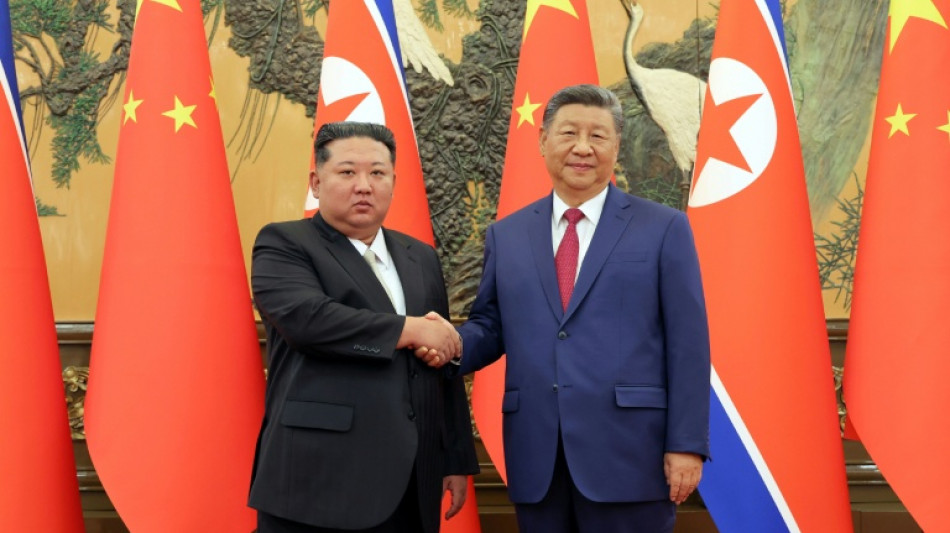
Chinese President Xi Jinping is set to arrive in North Korea on Monday after hosting back-to-back summits with US President Donald Trump and Russia's Vladimir Putin last month.
China, Washington's chief geopolitical rival, has been North Korea's main trading partner by far for decades and a key source of diplomatic and economic support for the country of around 26 million people.
Xi's visit comes as North Korea's nuclear talks with Washington remain deadlocked. The White House said last month that Xi and Trump "confirmed their shared goal to denuclearize North Korea" during their summit in Beijing.
Chinese foreign ministry spokeswoman Mao Ning said on Friday the two leaders would "exchange views on bilateral relations and issues of common concern", and "make greater contributions to regional and even world peace".
However, leader Kim Jong Un's powerful sister said just a day before Xi's arrival that North Korea's nuclear weapons programme was "the line of no retreat".
China has "always prioritised stability and is currently having to manage its relations and differences with the US", Minseon Ku, a diplomacy professor at DePaul University, told AFP.
"Beijing probably has accepted North Korea as a nuclear state," but Xi "will probably tell Kim that China wants stability more than anything".
Seong-Hyon Lee, a visiting scholar at the Harvard University Asia Center, also said Beijing is shifting towards "underwriting regime durability" rather than seeking to coerce North Korea into denuclearisation.
"China's broader regional strategy benefits from a stable, heavily armed, and aligned buffer state that absorbs US and allied military bandwidth," he told AFP.
- Elevated status -
North Korea has repeatedly declared itself an "irreversible" nuclear state since Kim and Trump's 2019 summit collapsed over the scope of denuclearisation and sanctions relief.
Trump met Kim three times in his first term, but his comment in October that he was "100 percent" open to another meeting went unanswered.
Kim has also been emboldened by the war in Ukraine, securing critical support from Moscow after sending thousands of troops to fight alongside Russian forces.
Some analysts say the summit could be Xi's way of countering Russia's growing influence over North Korea, but DePaul's Ku stressed that "overall, Moscow is not a major power like China".
"Moscow-Pyongyang power relations are more equal than Beijing-Pyongyang; Moscow needs Kim for their war in Ukraine as much as Kim needs technology sharing and food from Russia," she said.
Xi last met Kim in September, when he invited the North Korean leader and Putin as guests of honour to a military parade in Beijing marking the 80th anniversary of the victory over imperial Japan in World War II.
Analysts said that trip showed Kim's elevated status as he appeared alongside Xi and Putin at the spectacular military parade -- a striking display of his growing standing on the global stage.
- Taiwan counterweight -
Xi has hosted a series of world leaders as an increasingly unpredictable United States under Trump has pushed many to shore up alliances with Beijing.
Conflicts in the Middle East have also consumed more of Washington's attention, and Trump has made little progress on North Korea, especially on the nuclear front, despite his earlier high-profile summits with Kim.
North Korea is also the only country with an official, binding military alliance with China.
"America is currently engaged in offensive warfare potentially harmful to China's key interests, such as energy supplies," Vladimir Tikhonov, Korean Studies professor at the University of Oslo, told AFP.
"It appears Xi is trying to consolidate the alliance" with North Korea partly for that reason, he said.
Beijing claims self-ruled Taiwan as part of its territory, and North Korea could also serve as a useful counterweight to US partners in the region, including South Korea and Japan, analysts said.
Long-frosty China-Japan ties have deteriorated since Prime Minister Sanae Takaichi, a security hawk, suggested last year that Tokyo might intervene militarily in any Chinese attempt to take Taiwan.
"As China's international standing rises, Beijing is likely seeking to draw Pyongyang more actively into its diplomatic orbit," said Lim Eul-chul, a North Korea expert at Kyungnam University.
R.Song--SG